
LinkedIn is not a distribution channel
Before someone books a call with you, they have already observed you several times, not actively, but quietly. They’ve visited your profile, skimmed two posts, Googled your company name, and perhaps found an article you wrote months ago. Only after this ‘silent’ process does a willingness to engage emerge. And what is that, if not trust?
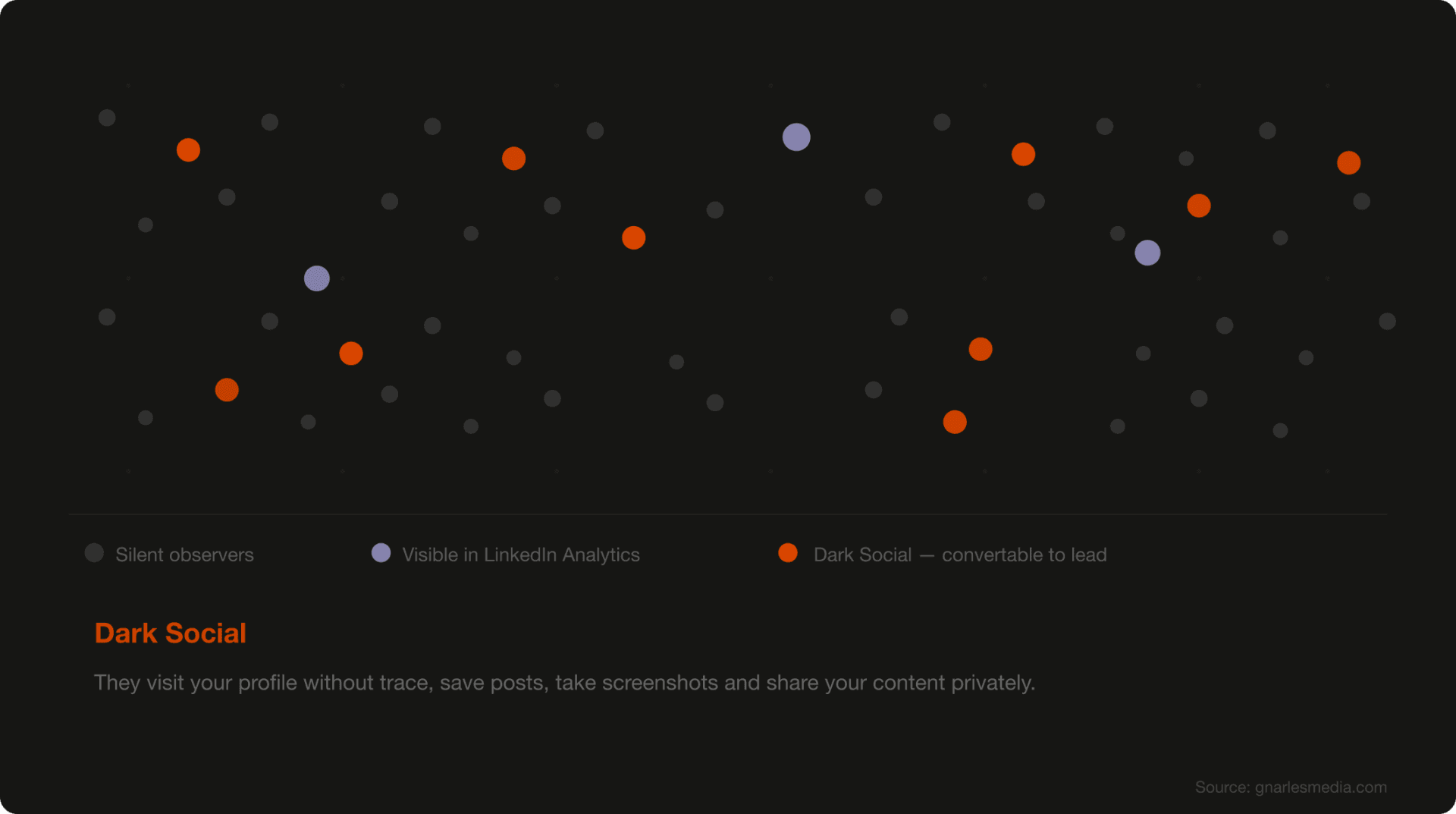
The sociologist Niklas Luhmann describes trust as a mechanism that reduces complexity and thereby enables decisions before all information is available.1 On LinkedIn, this means someone has already formed an impression of you before they reach out. This process unfolds largely in the shadows through saved posts, screenshots, forwarded links with previews, and direct profile visits that leave no digital footprint. This phenomenon is known as Dark Social, and it is particularly pronounced in European B2B, where decision-makers act more conservatively, comment publicly less often, and observe for longer. There are more views and more saves, but less public engagement. Dark Social comes with less measurability and greater dependence on consistent presence.
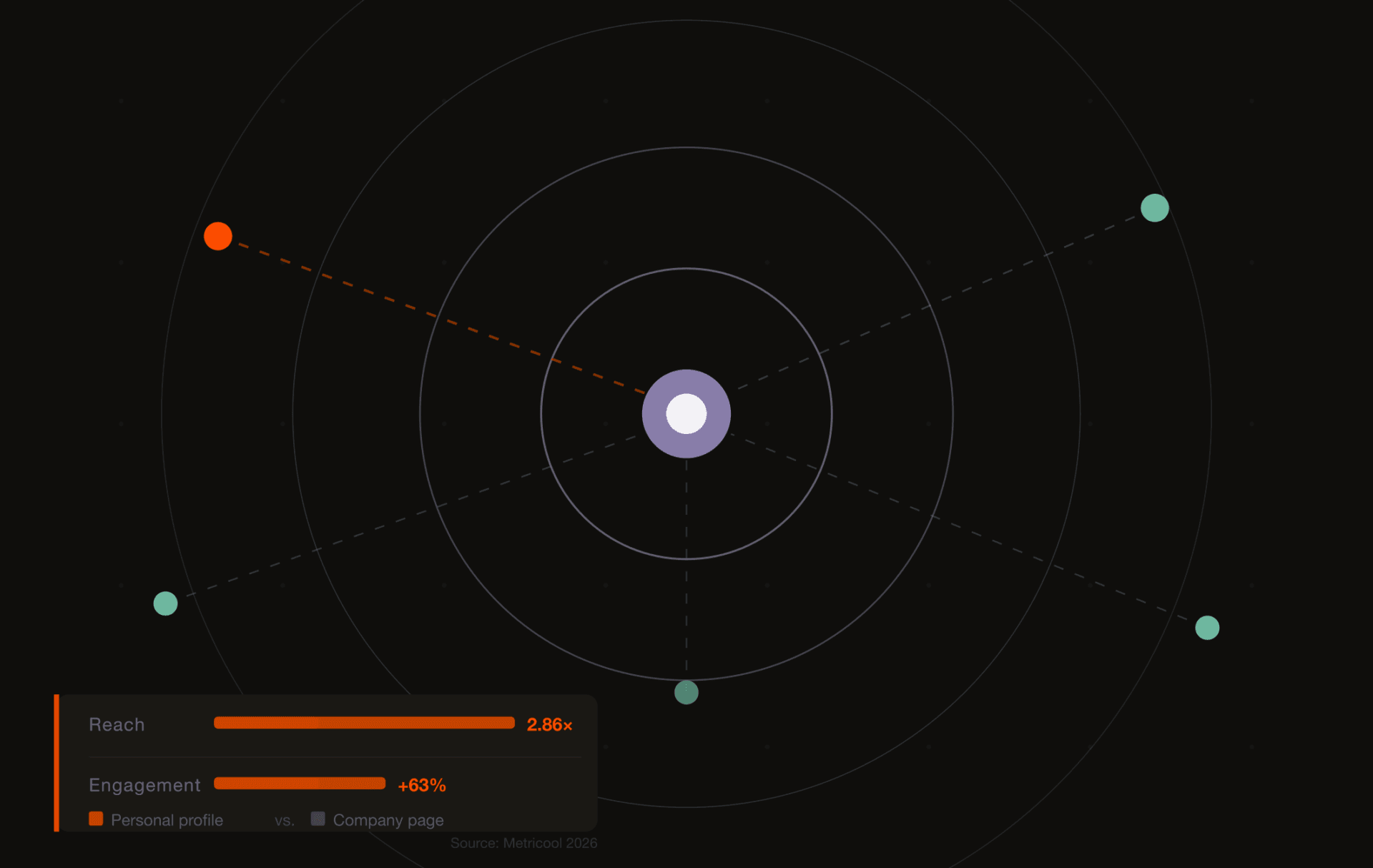
LinkedIn is therefore not a distribution channel but a trust infrastructure. Decision-makers follow individuals rather than company pages, because individuals hold a point of view whilst company pages tend to publish announcements and promotional copy. Data from a recent Metricool study confirms that personal profiles achieve a 63% higher engagement rate than company pages at nearly equivalent reach.2 Anyone who is not visible or who appears poorly positioned at the moment someone is quietly researching has already lost the race without knowing it.
A buyer Googles the founders before they even consider the offer. This isn’t merely an observation about LinkedIn content — it’s an observation about trust itself.
The three LinkedIn strategies in B2B: founder-led, team-led, or ABM
The most common waste on LinkedIn is not too little content, it is content without a prior decision. Anyone attempting all three growth paths simultaneously does none of them properly. And it shows.
Path A
Founder-led thought leadership
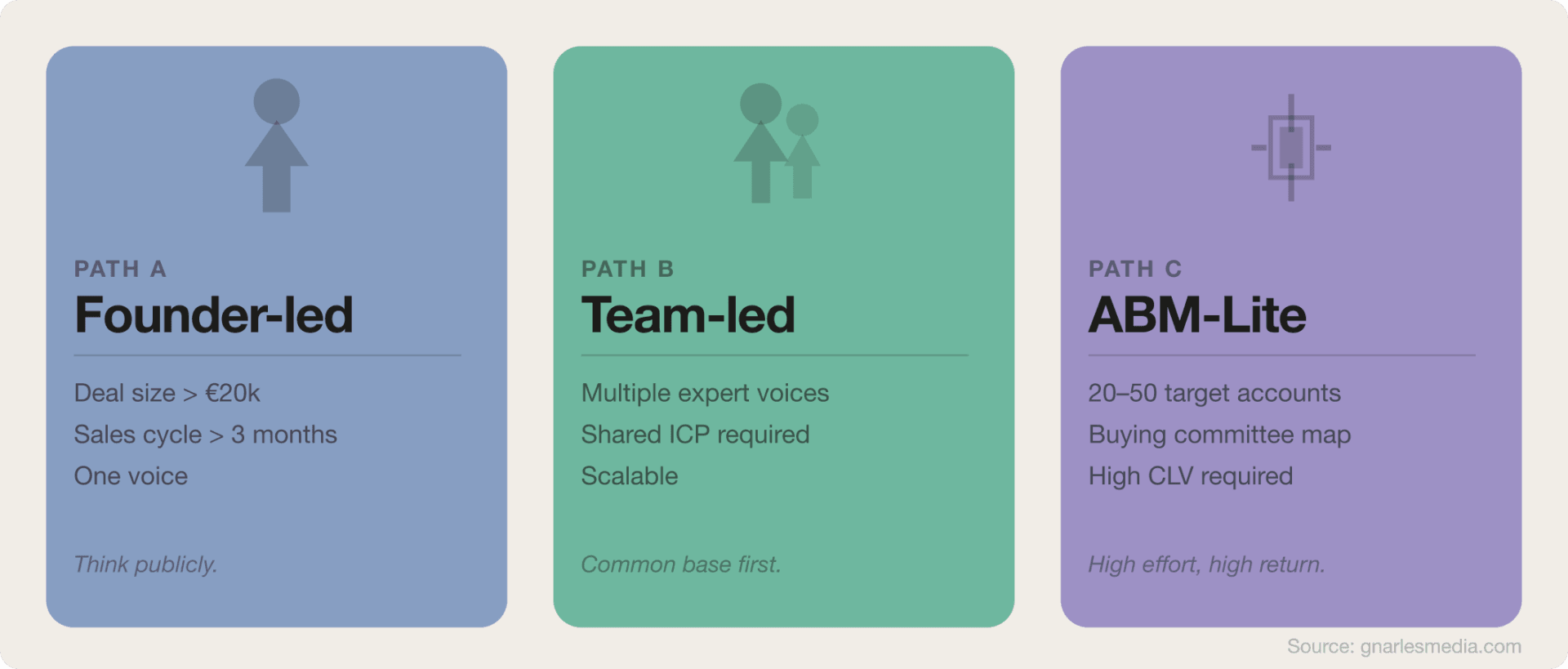
You as a founder are the differentiating factor. Your perspective, your mistakes, your assessments become the reason someone wants to speak with you and not someone else. This path works well for consultancy-intensive solutions, deal sizes above 20.000€, and sales cycles of more than three months. One prerequisite: you must be willing and able to think in public.
Path B
Team-led expert content
This means multiple voices from your team share specialist knowledge. This strategy is more scalable than the founder-led approach, but it requires a shared positioning. If the team is not aligned on the core message, it shows. Three different tones directed at three different audiences produce noise, not team content. The risk of experts taking their positioning with them when they leave is real, yet the investment remains worthwhile as long as the common foundation is solid.
Path C
Account-based LinkedIn (ABM-Lite)
You work with a fixed target account list of 20 to 50 accounts, you know the buying committees, and you plan touchpoints over weeks. This path demands significant effort whilst delivering significant returns. Ideal when customer lifetime value justifies it. For everyone else, this is the wrong path at the wrong time.
Choose one path. Test it for 90 days. The anti-pattern of ‘doing everything’ costs more than it delivers.
Positioning: the step most people skip because it hurts
Positioning should not be a headline exercise, it is the decision about who you are not writing for. This decision is harder than most people expect, because it feels like a loss. ‘We help companies grow’ is not a positioning — everyone says that. ‘We help B2B start-ups entering the European market to win their first enterprise clients without a sales team’ — that is a clear positioning. You might disagree with it. You might also remember it. Either way is definitively better than being forgotten.
A simple framework holds communication together: Who is your target client specifically, not as a target audience description? What specific problem do you solve, and why don’t they simply solve it themselves? What makes your approach different, better suited, more precise for exactly this person? And where is the proof, e.g. case studies, numbers, references? Scepticism towards hype marketing is deeply ingrained in European B2B, and business owners make decisions conservatively with a low appetite for risk. This is precisely why building trust early matters so much.
Case Study · Byoms
When Byoms, a Danish company producing probiotic cleaning products, wanted to grow in the German market, the barrier was not their offering. Their products are excellent. The question was: who is the right contact in German B2B for a white-label offer, and how do you approach them without sounding distinctly Danish-Scandinavian?
gnarles media ran a workshop to define ICPs for the German market, identify target accounts, and develop personal branding strategies for all three founders. Bilingual landing pages for the white-label offer were created. Only then followed the LinkedIn outreach campaign. The order is non-negotiable. Positioning must always precede a campaign.
The profile that serves the silent researcher
Your LinkedIn profile is the first thing someone sees when they quietly research you. It is not a CV, it is an answer to a question that is never asked aloud: why should I speak with this person? As long as the profile fails to answer that question, everything else is secondary.
Communication succeeds when the claim to truthfulness is met. The challenge is that credibility cannot be asserted, but it must be demonstrated through context and action.3 A LinkedIn profile that achieves this is a genuine communication offer.
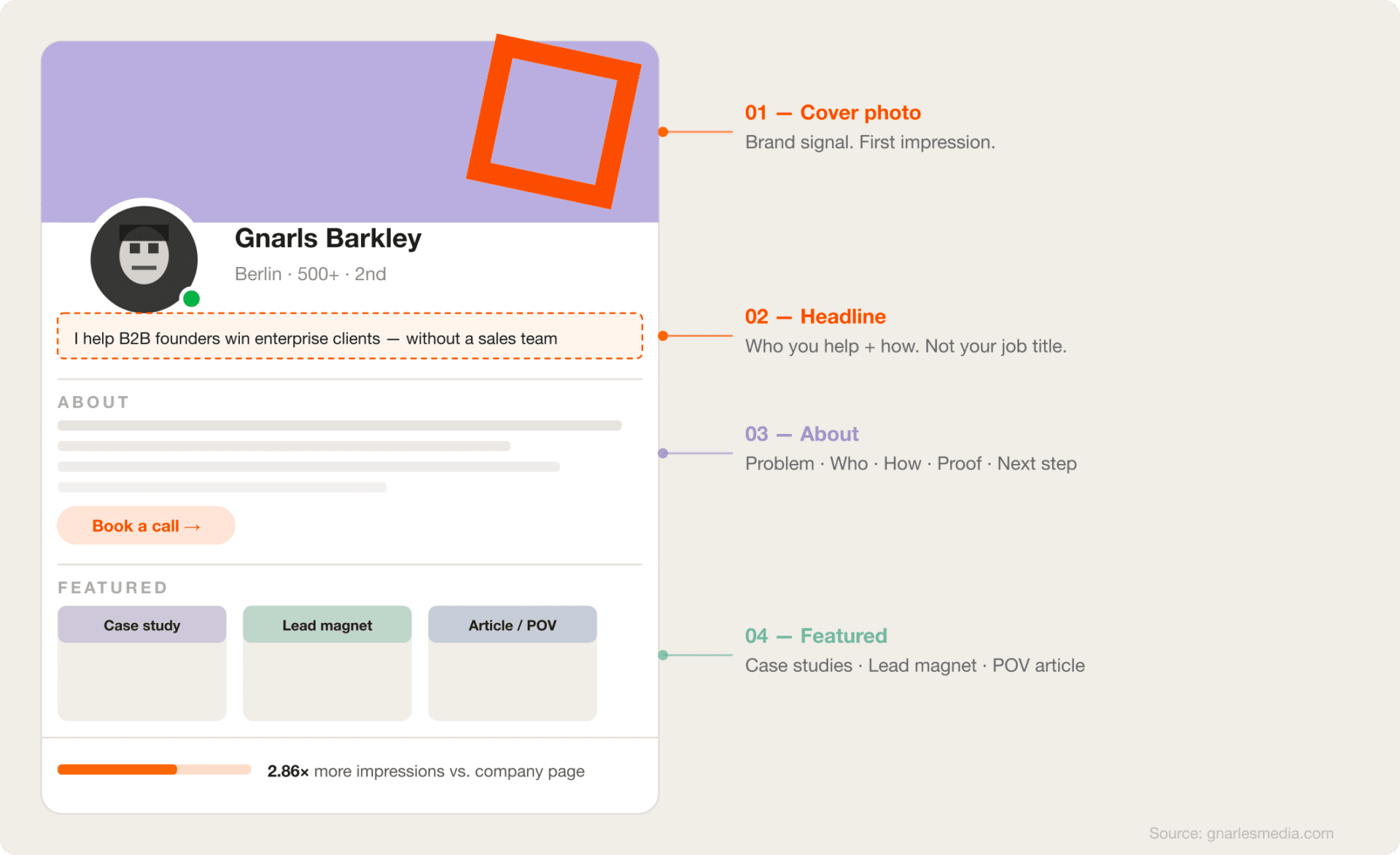
The headline decides first. It should not centre on a title such as ‘Founder & CEO at XY’ — what matters is who you help and with what. The About section follows the same logic across five paragraphs:
- The problem you solve,
- for whom,
- how,
- the proof,
- and a clear next step.
The Featured section is wasted potential on many profiles. Yet it is ideal for actual proof: case studies, webinar recordings, a lead magnet, an article that demonstrates how you think. Company pages, incidentally, are a waste of time until team members are linked and actively posting, at which point they become a multiplier. Text on personal profiles achieves 2.86 times more impressions than the same format on a company page.4 In short, what you write personally travels further than what the logo posts.
Content formats that build trust in B2B
The most common mistake is content written for everyone, like generic tips, lists that surprise no one, perspectives that challenge no one. European B2B content works somewhat differently from what American feeds have conditioned us to expect. Less storytelling drama is required; more substance, a critical perspective, or concrete proof.
01 Problem clarification
A compelling way to demonstrate expertise is to surface a mistaken assumption held by your target audience — not to criticise them, but to do them a genuine service. The problem clarification must remain central. It works when readers feel understood, and it plants the thought: this person knows what I’m wrestling with.
Most B2B start-ups believe they need more content and must post more often when the pipeline is empty. In eight out of ten cases, however, the real barrier is their positioning or the positioning of their content, not the frequency.
02 Proof
Case studies deliver proof. They require context. The classic structure covers the starting point, the decision made, and the outcome. Measurable data and hard numbers are a significant advantage, though they must be traceable, meaning the reasoning must be made clear for a genuine point of reference to emerge.
A logistics start-up had an innovative approach and real clients already. We spoke with their team about their customers and the challenges they faced. We translated these into hooks and stories, like small problem-solution narratives, and used them to steer positioning on LinkedIn.
03 Point of View
Successful opinion pieces often contain a counterintuitive thesis, argued with care. If whilst writing you think ‘is this too direct?’, that is a signal it is exactly right.
LinkedIn does not become a lead machine when you post more. It becomes a lead machine when what you post makes someone want to know more. Then they also want to speak with you.
04 How-to
Step-by-step guides, templates, and frameworks are also an option, but only if you genuinely have something to offer. A framework you actually use yourself is credible. Inventing one for the sake of a post is not worth the effort.
Two to three times per week is realistic and sufficient. Consistency beats frequency. Peak times are Tuesday to Thursday, early morning between 7 and 9am, or evenings between 5 and 7pm. We do, however, continue to identify new sweet spots.
Case Study · Down Under Film Festival
The Down Under Film Festival wanted to expand its presence across Europe: more cities, more film submissions, more ticket sales. What it lacked was a content strategy that could function without a full-time team and outside its screening season.
gnarles media developed a strategy that was explicitly executable by volunteers, whilst simultaneously positioning the festival directors through opinion pieces. The guiding principle: a strategy that fits the team’s reality delivers more than one that fits an ideal image. The result was more film submissions, more followers, and more ticket sales.
What now? The next step before the first post.
We do not treat positioning, profile, content, and hooks as a setup to be ticked off once. They are the foundation you actively work with. If anything here is unclear, even the most targeted outreach campaign will struggle. A clear positioning makes every post an argument, and it is how a profile visit ultimately becomes a lead.
Write down your four positioning elements. If you finish within ten minutes and read it back thinking ‘yes, that’s exactly it’, the foundation is in place. How to turn that into conversations without cold-pitching, which metrics actually matter, and where most founders trip up, you’ll find all of that in Part 2 of our article: Outreach, Measurement, and the Stumbling Blocks That Really Count.
- Niklas Luhmann: Trust and Power, Wiley, Chichester 1979. Luhmann describes trust as a mechanism that enables decisions before all information is available. ↩︎
- Metricool: LinkedIn Study 2026, n = 673,658 posts. Download: metricool.com/linkedin-trends-study/ ↩︎
- Jürgen Habermas: The Theory of Communicative Action, Vol. 1, Beacon Press, Boston 1984, p. 412. Habermas died on 14 March 2026 at the age of 96 in Starnberg. He formulated four validity claims that successful communication presupposes: intelligibility, truth, truthfulness, and normative rightness. The claim to truthfulness, Habermas argues, can ultimately only be redeemed by a speaker “in contexts of action” — not through statements alone, but through consistent conduct over time. ↩︎
- Metricool: LinkedIn Study 2026, n = 673,658 posts. Download: metricool.com/linkedin-trends-study/ ↩︎